The original concept of the "British Mode" came from an unusual setting on the classic UREI LN1176 limiter. The unit was designed to have only four ratios, each ratio being engaged by selecting one of four buttons. However, as early as 1980 (or before), renegade recording engineers, always on the lookout for something a little more "over the top", found that you could make all four buttons stay "in" if you pressed them just right. What resulted was a very, very aggressive sound that had some elements of the units 20:1 ratio, but with an unusual knee and new envelope shape. Somewhere along the line, someone called it a "British Mode" and the name has stuck. It is also called "all buttons in" and some other intuitive names.
The Distressor has the advantage of being able to apply this "aggressive" nature not only to the new British ratio (1:1) but also to all the ratios since a separate switch is installed, which can be enabled with any ratio. One should keep in mind however, that an attack below 3 or 4 is required to maintain the LN1176 character. If you go above an attack of 3 you will also incur a rise in some grunge (distortion) and see the THD indicator lites come on a lot more. The Distressor will no longer behave smoothly, nor like an 1176.
The Empirical Labs EL8 Distressor is an automatic gain (or volume) control device (AGC in engineering terms) designed for pro audio applications. It electronically controls the volume of just about any source in a very pleasing, and "musical" manner - adding fullness, intelligibility, and especially in the Distressor's case - excitement. This type of device is often called a "limiter" or "compressor" by audio industry people. It is for use in recording studios, live sound situations, movie sound production, and radio broadcast production.
Unlike most analog compressor/limiters the EL8 Distressor is a digitally controlled audio device and actually incorporates several products into one by utilizing digital controls to switch totally different circuits in and out. Years of beta testing and redesign went into the Distressor as will be the case with all Empirical Labs products.
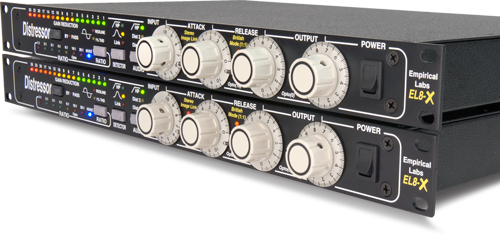
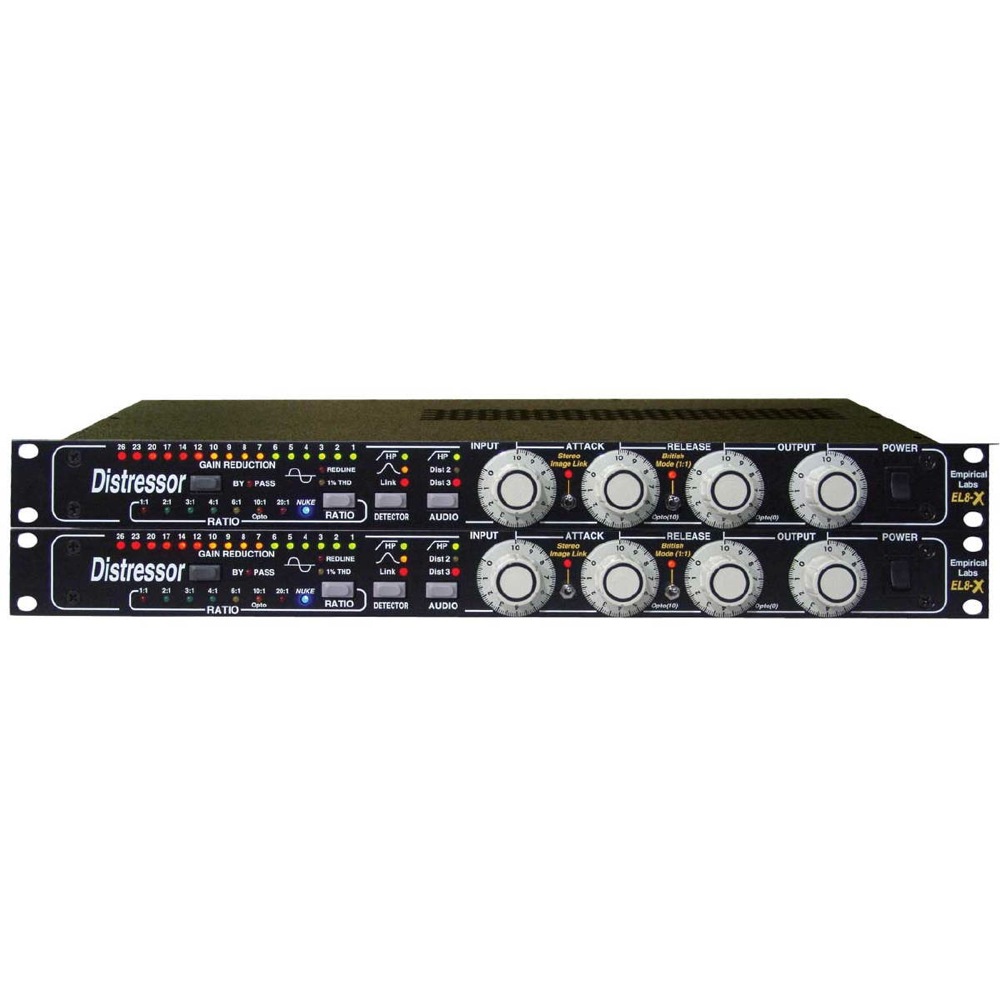
Empirical Labs EL8X-S Distressor Features :
- 2 Factory Matched EL8X's with British Mod and Image Link Feature, Stereo Link Cable Included / Stereo Strappable
- Classic knee sound - Delivered with modern noise specs in an indestructible, digitally-controlled, single-height box. Really grabs.
- Programmable analog distortion/warmth - Helpful in the pristine but unforgiving digital world. Three audio modes provide user programmable, warm harmonic distortion. Emphasized tube-like 2nd harmonic in clean and Distort 2 mode. In Distort 3 mode the distortion becomes dominated by 3rd harmonic (similar to tape).
- Distortion indicator lights - A 1% LED and a "Redline" (3%) LED. No hard clipping until a few dB past "Redline."
- Advanced built-in sidechain EQ - High mid-band emphasis prevents harsh, edgy guitars or vocals from hurting innocent ears. Low cut keeps the low "sum & difference" frequencies from pumping the upper frequencies of source material.
- Eight unique curves - From the 1:1 mode that simply warms up signal with low-order harmonics without intentional compression, to the "Nuke" setting - a brick wall limiting curve that shines on live drum room mics. Each curve has its own personality and release shape. Most exceptional is the 10:1 "Opto" ratio which uses separate circuitry to emulate the oldest (and most valued) "light-controlled" devices, such as the LA2A. Manual provides complete setting instructions for emulating other compressors of old. Its like getting several totally different compressors in one.
- Huge knobs with high resolution numbering - For easy readability and repeatable settings. They also go to 10 1/2.
- Locked & calibrated output level - Allows speed in setting tape and live mix levels.
- All metal film and Roederstein resistors in the audio path - Top quality components, mostly military grade.
- Unique "Binary Stepped Interface" - Provides hundreds of options with very few controls.
- Fool proof operation - Even though there are 384 possible settings (not counting knob settings), it's almost impossible to get a bad sound. Keep all knobs on 5 or 6 (around middle) with ratio at 6:1 and you won't go wrong.
- Over design power supplies - Runs cool, allowing cabinet to be sealed without heat vents. Long life components.
- Single height and light weight - Classic sound in a small, extremely reliable package.
- True bypass - Know what it's really doing. All contacts doubled up for maximum reliability. No internal audio connectors.
- XLR and 1/4" phone ins and outs - XLR fully balanced, transformerless design, pin 2 hot. Changeable by user to pin 3 hot!
- Hand wired and calibrated in USA.
Besides offering a wide range of control and unique features, the Distressor offers a warm, vintage sound by using a custom designed gain control circuit. This "warmth" or vintage sound has become an important issue in the last 15 years, as the super clear and linear digital technology does very little (or nothing) to soften "harsh" sounds nor emphasize the bass frequencies in music sources. Older analog tape, vinyl records and tube equipment on the other hand, could not be prevented from coloring the sound, often to the frustration of recording engineers. However, many people have now realized that this coloring can be extremely pleasant and "musical".
The current digital technology is often referred to as "cold" and "brittle" among other terms, although we prefer the term "unforgiving" to describe the negative side of the "linearity". The Distressor offers several modes that color the signal, even without compression (or gain control). These extended modes were designed to allow emulation of some very old and some very expensive vintage gain control units (compressors & limiters) and deliver a classic "knee" sound all its own.
About the "Brit Mod" :
The Distressor "British Mode" Option - upgrade & option for your Distressor!
Basic Description - The original concept of the "British Mode" came from an unusual setting on the classic UREI LN1176 limiter. The unit was designed to have only four ratios, each ratio being engaged by selecting one of four buttons. However, as early as 1980 (or before), renegade recording engineers, always on the lookout for something a little more "over the top", found that you could make all four buttons stay "in" if you pressed them just right. What resulted was a very, very aggressive sound that had some elements of the units 20:1 ratio, but with an unusual knee and new envelope shape. Somewhere along the line, someone called it a "British Mode" and the name has stuck. It is also called "all buttons in" and some other intuitive names.
The Distressor has the advantage of being able to apply this "aggressive" nature not only to the new British ratio (1:1) but also to all the ratios since a separate switch is installed, which can be enabled with any ratio. One should keep in mind however, that an attack below 3 or 4 is required to maintain the LN1176 character. If you go above an attack of 3 you will also incur a rise in some grunge (distortion) and see the THD indicator lites come on a lot more. The Distressor will no longer behave smoothly, nor like an 1176.
How to use the new British Mode Option for the first time
Put the unit in the 1:1 ratio and turn on the British Mode Switch (flip it up and the LED should be lit). That enables it. To sound like the 1176 the only constraint is to keep the attack well under 4 on the Distressors - their attack can go much longer than the 1176. Now you will find that the unit has a new attitude! The attack and release will generally be more aggressive and the unit will get in and out of the way very quickly. Interestingly, the unit will be slightly less colored when not compressing.
Tips
Use this ratio to "skim" peaks. This means that most of the time it may not be doing anything, but when it does "hit" the signal, it will smoothly push back the signal and then get right out of the way again. If you are hitting the Gain Reduction all the time with the British mode on, you are going to be really "squashing" the signal. On the other hand, the Distressor will sound fairly subtle when compressing all the time in 2:1 mode, especially with a slower attack (>6).
Tricks
* Vocals! - This is a great final compression during mixdown. When not working it is very transparent, but when a vocal pops out and hits the compression, the British mode will get in and out of there quickly and smoothly. When you are really compressing a lot, breaths and background noises will become very loud (pushed up). There is not much you can do with this except gate before compression maybe or, mute or erase the noises and breaths out that you don't want to hear. Remember that breaths are natural and can add a lot of excitement sometimes, so don't gate or erase them by default. If you can, back up a vocal track before you start trying to punch out breaths and noises etc.
------------------------
About the "Stereo Image Linking Mod" :
Stereo Image Linking for the Distressor - a hardware option for your Distressor!
Basic Description - The original Distressor stereo link implementation used a summing and phase detection method which allowed stereo image shifting. "Image shifting" occurs when the interchannel balance (the relative volume between Left and Right channels) changes during compression. Although known for its phase correction, and its "thickening" on open room mics and other stereo sources, this approach has sometimes been a problem on stereo program material where the producer/engineers want to maintain absolute left/right balance at all times.
With the new "Stereo Image Link" option, the Distressor user now has three link options - the original "phase" link, the new Image Link and the combination of the two, phase and image linking. This has never before been offered on any compressors or limiters. There can be very slight differences in the metering between the two units. Due to the high resolution of the Distressor's metering, 1/10th dB can make an LED on one unit go on or off earlier than the other unit's. Also, don't readjust knob alignment - the output pots especially. They are often offset around "0" to allow for "dead spots" at the lower extremes.
How to use the new Stereo Image Link Option for the first time:
You must now use two stereo phone plugs in the link cabling. This means standard TRS phone plugs. They are supplied when you purchase the option. Plug one unit's Link Out to the other's Link In, and vice versa. Both units must have the "Stereo Image Link" switch on (both switches should be in the up position and the LEDs should be lit). The engineer must still match the units' front panel controls usually, but the units will now always match in their gain reduction amount - eliminating image shift. The most important thing the user must do is match the left and right input and output levels. If no change is going to be made to the left/right balance, using a tone to set the left right I/O levels is very direct and useful. See below.
Tips
Setting I/O levels - It is suggested that you set both units to their general expected settings, with Stereo Image link engaged, apply an identical tone to both Distressors, and adjust the inputs nearly the same, then "tweak" the outputs so that the output levels are identical. Use the meters on your board or recorders. This will ensure that the interchannel levels remains unchanged. Also, with the new linking, it is not as critical to match either the input or outputs, since the gain reduction between the two channels is locked, and therefore once the overall throughput levels are matched, they will remain that way. However, the units can respond more to the louder channel if the input levels are not matched closely.
Back to Top
Tricks
* First, there is no limit to how many units can be linked - in theory. However, you must avoid long link cables since they will cause noise and degradation of operation. To wire up more than two units, go from the link output of the 1st unit's link to the next units link input, then take that units link out to the next ones input etc. Finally, take the last units link out and feed it back to the first units link in. Again, your must use stereo phone plugs for the new "Stereo Image Link" to work.
* Try putting the lower unit into 1:1 mode with attack and release on 10. Then still matching the I/O levels, use the upper unit to select ratio and attack/release times. This will allow a longer attack time then otherwise available, since the top unit must drive both units timing circuitry. The down side is that the units will only respond to the top units signal, unless the original link is engaged (see below). There are a few well known compressors that have a master/slave mode that only looks at the "master units" audio - so this is not unheard of. You may switch the units and have the bottom one control the top unit (which is in 1:1 mode). Also, using the original link will sum both channels partially, so that there is some response to the "slave" units audio. This longer (slower) attack time is sometimes very useful on program material - a la SSL type compression.
* By not matching the units front panel controls - whole new ratios can be obtained. For instance, putting the left channel on 2:1 and the right channel on Nuke (pretty radical but..), then setting the left and right levels differently, you can get a combination of two ratio curves. Usually the lowest attack/decay settings will override the higher settings, i.e. if one channel has the attack set to 10 and the other to 3, the units will generally react at the faster 3 setting.
* If for some reason no TRS stereo link cables are available, one may use a regular guitar cable to enable the new link. But you only insert the cable part way into the rear Link connectors - so that only the ring is in contact with the tip of phone plug. The normal EL8 link will be sacrificed, however, since it relies on the tip of the link connectors to be connected. It is probably best not to put the unit in normal link (in the Det area) since it will make the unit operate with more distortion without the tip connections - then again this mite be the perfect spice for your gumbo!
The History of Empirical Labs :
Empirical Labs Inc. (ELI), designs and produces professional audio equipment and software. This includes equipment used in recording studios, live sound, broadcast studios and other audio production facilities etc. They also make software for digital signal processors. This product, was designed in 1994, tested and revised for several years, and released in early 1996. The Distressor is the first in a series of audio products from ELI that will offer original features, ease of use, long product life, and a very musical audio path.
Empirical Labs was started in 1988 and functioned mainly as a recording studio and electronics consulting firm. The founder, Dave Derr, was also employed at the time by Eventide as an audio engineer. Dave was part of the core design team for the H3000, H3500, and DSP4000. His experience at Eventide proved valuable for his later work. Dave was exposed to great engineering and the modern world of digital signal processing (DSP).
In 1998, Empirical Labs closed the doors of the recording studio. The sales of the Distressor had flourished after a shining review appeared in the December 1996 issue of Mix magazine. Later that year, the company picked up and moved to a larger facility to meet their increased production requirements.
Another goal of Empirical Labs is to make their products less prone to obsolescence and be easier to update, modify or repair. Instead of entire new products that may be outdated in 2 years, their thinking is to make a few great products that can be supported and upgraded for decades.
Empirical Labs' engineers & technicians are encouraged to play with and use their designs along with other expert beta-testers. The word Empirical in its most positive interpretation means, fashioned from experience. Empirical Labs considers real world use to be one of the best resources in developing innovative, user-friendly and robust designs. Before final release, all of their products will be extensively tested in the environments for which they are designed. They will not throw products out there and see what sticks.
Their Philosophy is very simple - but very hard to live up to :
Empirical Labs wants to make products that work a little easier, a little better, and a lot longer - and make sure they are fun to use.