
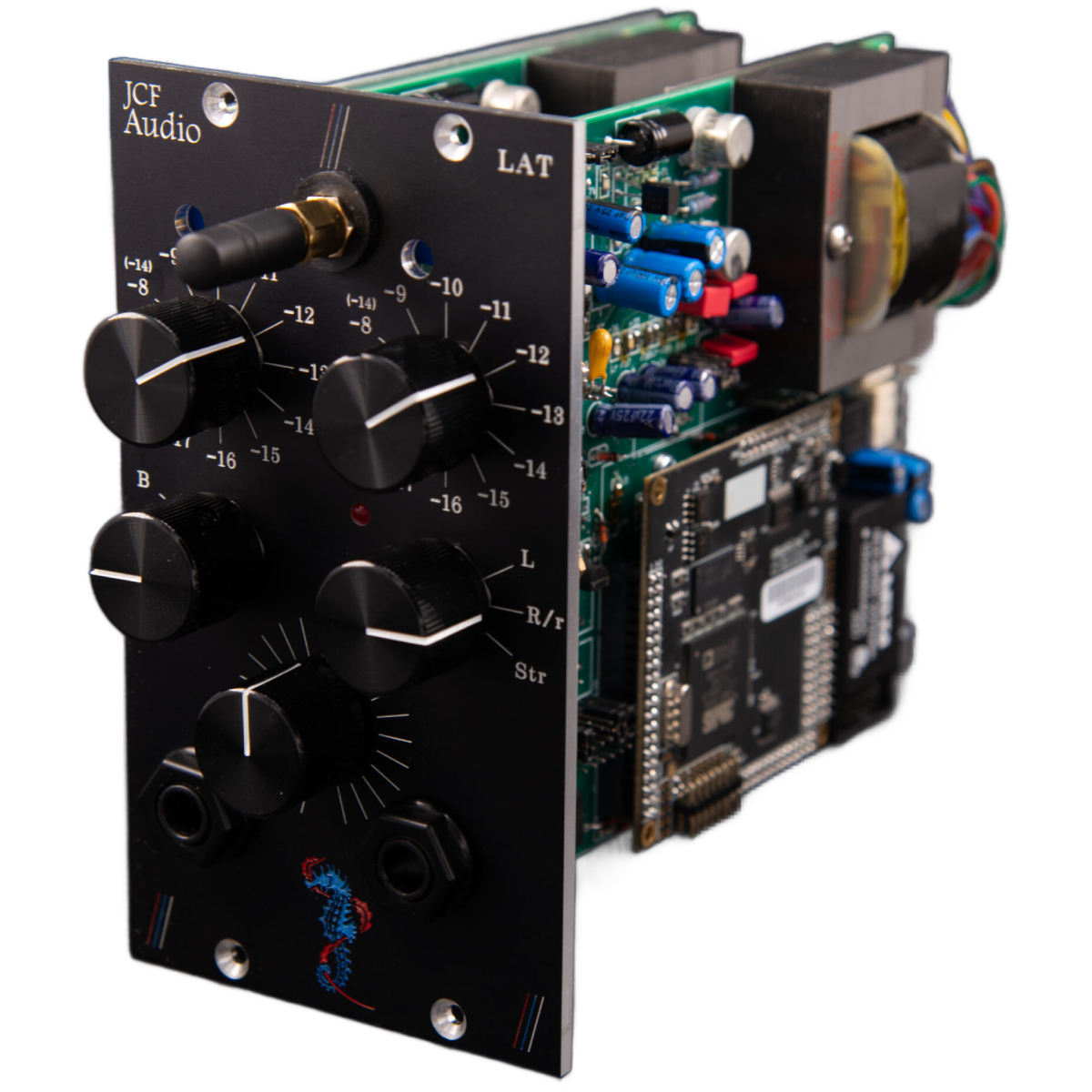
JCF Audio LAT High-Resolution Digital to Analog Converter
$5,270.00
The JCF Audio LAT is a High-Resolution 2 channel Digital to Analog converter with wifi streaming, AES, all new in-standard-500-rack sync, and a headphone amp.
In stock

Description
JCF Audio LAT High-Resolution Digital to Analog Converter
The JCF Audio LAT is a High-Resolution 2 channel Digital to Analog converter with wifi streaming, AES, all new in-standard-500-rack sync, and a headphone amp.
The LAT is a High-Resolution 2 channel Digital to Analog converter for the 500 series format that follows somewhat in the lineage of the DAC section of the Latte.
The unit is a two-slot device and receives the industry standard AES/EBU protocol through either 500 series inputs. Dual-wire configuration is available as well. The LAT can derive its sync/data source at all pro speeds from either of the AES/EBU input sources, the Pin 6 buss when streaming is not active, or the internal reference of the streaming module. The left-hand side of the unit’s AES/EBU input becomes an output by default when not selected as the active input source. This signal can be utilized with a simple XLR adapter in the case of XLR connections if applicable. The large “R” denoting “right” input and the small “r” denoting “r”emote source/output selection if connected to the forthcoming JCF Audio Somta modular monitoring system.
PEP processing is not standard on the LAT but can be installed and configured to be used or not under one of the generic A or B functions on the front panel. All available input streams can be processed with PEP if PEP is installed and selected to be engaged.
The analog outputs on the LAT are available in two different forms. Transformer coupled fully-floating outputs OR an RC coupled “quasi-balanced” output aimed at monitoring applications. It’s important to highlight the quotes here as there isn’t anything quasi about “quasi-balanced” outputs. They’re balanced. Both output styles are well-suited for studio environments and switching between them can be assigned to one of the A or B functions on the front panel as well. The “quasi-balanced” output has 6dB less output level hence the reduced scale markings on the stepped attenuators. That’s right folks. Transformers on switches. Hell freezes over at least for this one special purpose.
The headphone amplifier has two output jacks and can feed a lot of current to whomever is listening so users please be careful with your hearing. The 500-series inputs can be routed to be two analog input sources to the headphone output. The level is controlled by the potentiometer while the DAC is doing other things with either the pin6 buss input or the streaming module and the combination of the steps and trimmers. In fact, a number of combinations of the two attenuator styles, analog and digital inputs, and both output ports are available and are discussed in the tables later in this manual.
A configurable output pad is also on-board for direct interface with power amps or powered speakers. The pad is selected with jumpers for one of three different amounts of attenuation and applies for either output type.
Front Panel Controls
Level – These level adjustments at the top of both sides of the unit are graduated in 1dB steps. Accompanying these controls are two vernier trimmers accessible through holes in the front panel. The trimmers provide approximately 1dB of adjustment in each direction to center the scale. The 11 step scale covers a sensible range of calibration levels for both transformer and “Quasi-balanced” styles. Calibration and max/min level details are listed in the Specifications section.
Input – The middle right hand switch selects the source for the unit. The selections are the L denoting the presence of AES/EBU at the left rear input, R/r denoting the expected presence of a valid AES/EBU signal at the right input, and Str denoting the use of a valid AES signal on pin6 if the streaming module is offline or the direct use of the streaming module while active.
Function – The middle left hand switch has two programmable functions A and B. The no-function position is in the middle at 0. Functions A and B can be chosen to be two or more the following possibilities with some restrictions that are detailed in the charts in a later section of the manual: Activation of the rear inputs as analog inputs to feed either attenuator, DAC digital filter sharpen, the selection of transforming coupling at the output or absence thereof, and PEP in and out if applicable.
Potentiometer – This control always adjusts the level of output at the headphone jacks. This control in some jumper configurations also controls the main output level.
Headphone Jacks – Both jacks are available with identical signals to feed one or more sets of headphones.
Features:
- No AI
- Low group delay
- Sleek Dual 500 slot design
- Selectable output type and level to suit job
- < 7W consumption
- PEP processing optional
To learn more about JCF Audio ,Click Here
Additional information
| Brand | JCF Audio |
|---|---|
| Condition | New |
Technical Specifications:
- D/A Calibration Range:
- MAIN OUTPUT (Jumpered for potentiometer source) - "Quasi-balanced" out
- MIN:
- Pot fully counterclockwise
- 0dBFS = No output |-18dBFS = No output
- MAX:
- Pot fully clockwise
- 0dBFS = +22.8dBu MOBC / +1.2 over clip |-18dBFS = +6dBu
- MAIN OUTPUT (Jumpered for potentiometer source) - Transformer out
- MIN:
- Pot fully counterclockwise
- 0dBFS = No output |-18dBFS = No output
- MAX:
- Pot fully clockwise
- 0dBFS = +28.8dBu MOBC / +1.2 over clip |-18dBFS = +12dBu
- De-Emphasis is not available in the LAT
- Power Consumption: < 07 Watts
- Analog Output Impedance:
- No pad condition:
- "Quasi" out: 200 Ohms (100 per leg)
- Transformer output: ~200 Ohms floating
- -20 pad condition: 154 Ohms
- -30 pad condition: 40 Ohms
- Input Impedance
- Digital: 110 Ohms floating rear, pin6: 75 Ohms
- Analog: 30k (CM)
- Frequency Response (relative to 0 dB @ 1k):
- 48kHz : 20Hz +0.1dB | 20kHz -0.1dB
- 96kHz: 20Hz +0.1dB | 20kHz -1.1dB | 30kHz -2.3dB | 40kHz -3.7dB
- 192kHz : 20Hz +0.1dB | 20kHz -1.1dB | 50kHz -5.0dB | 70kHz -7.8dB
- Shipping weight: 4 lbs. 11" X 11" X 6"