My Account Track OrderCart: 0 items › Total $0.00
(888) SC4-GEAR
724-4327
Intl. +1 (802) 365-9190
Bookmark and Share

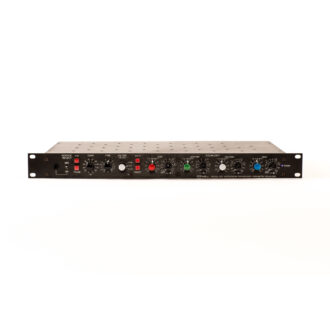
GML 2032

Channel Strip Mono Class-A Microphone PreAmp with 4-Band Fully Parametric Equalizer
The famous GML 8300 discrete mic pre and a 4-band version of the 8200 parametric EQ are incorporated in to this sweet 1U channel-strip. It has all the features and stellar sound-quality you expect from GML, plus the advantage of a built-in power-supply (no external psu needed!).

Quantity:

Need Help? Ask the pros at Sonic Circus Call: 888-SC4-GEAR or
The Model 2032 Microphone Preamplifier / Parametric Equalizer is a single-channel, multi-input device for high-resolution studio and remote applications.

Based on the reference-standard Model 8300 Transformerless Microphone Preamplifier and Model 8200 Parametric Equalizer, this flexible 1U processor continues the GML engineering tradition while bringing the utmost in transparency, detail, and musicality to an affordable, compact form factor.
The GML 2032 includes it’s own internal power supply.


GML 2032 Features :
  • All-discrete, Class-A design; no integrated circuits to compromise the audio path
  • DC-servo and premium-grade film coupling; no interstage capacitors to add distortion or degrade over time; no tantalum electrolytic, ceramic, or aluminum electrolytic capacitors in the signal path
  • Transformerless; precision electronically balanced inputs
  • Designed with GML 9202 (single) and GML 8501 (dual-differential) lownoise, low-distortion, wide dynamic range, wide bandwidth precision discrete opamps
  • DC-servo stabilized direct-coupled output
  • Multi-input format: MIC or MI (front panel musical instrument)
  • Wide gain range (10 dB to 75 dB) available on both inputs
  • Precision Gain switch: 65dB range in 5dB steps
  • Continuously variable preamplifier Fine gain control, +/-5dB
  • Four-band fully parametric equalizer
  • Low-frequency and High-frequency Shelf mode capability
  • Flexible routing: Single-Channel, Independent, Inline Insert configurations
  • High-pass Filter; selectable 40 Hz, flat, 100Hz
  • Front panel Phantom and Phase illuminated switches
  • Front panel EQ IN and Insert illuminated switches
  • Overload (OL) indication LED and Power status LED
  • Low-noise, highly regulated internal linear power supply
  • Modern surface-mount construction, yielding maximum precision, manufacturability, and reliability
  • No internal signal interconnects; high-quality signal relay switching
  • Carbon-film and conductive-plastic custom precision potentiometers, manufactured to GML exacting standards
  • Multi-colored knobs, GML standard
  • Stylish and durable black-anodized aluminum front panel
  • Rugged chassis; black powder-coat finish over aluminum
  • Reverse-anodized front panel legend, much more permanent than ink or paint processes
  • Baked-on epoxy paint silkscreen rear panel legend
  • Quality PCB manufacturing, assembly, and chassis construction


The Preamp section of the 2032
The preamplifier section of the Model 2032 Microphone Preamplifier / Parametric Equalizer is based on the gain stage of the Model 8300 Transformerless Microphone Preamplifier, though there are some design changes and a few additions to expand its capabilities further than is realized in the highly specialized Model 8300 mic preamp.

A particularly wide range of gain settings (10dB through 75dB of gain) is available for both preamplifier inputs of the Model 2032. This feature accommodates a broad array of input signals, from extremely "hot" microphone inputs to extremely "low" MI inputs, which are often neglected by professional peripheral audio processing devices. Indeed, the minimal 20dB of gain found in most microphone preamplifiers can be excessive in certain circumstances, and decreases the possibility of optimized gain staging. By the same token, real-world MI signals often require more than the typical 10 dB of gain commonly accorded them.

A combination of the rotary Gain switch and Fine potentiometer is used to control the gain setting of the preamplifier section, with the overall gain of the preamplifier calculated by adding the two control values. The Gain switch allocates between 15dB and 70dB of gain in precise 5dB steps, using a combination of discrete resistors for the ultimate in accuracy, stability, durability, and sonic integrity. Providing +/-5dB of continuously variable gain, the Fine control adds elasticity to gain setting.


Multiple inputs for today's desktop and professional studios!
The inclusion of multiple inputs certainly adds to the allure of the Model 2032, where the MI input circuitry represents a welcome addition to the standard microphone input. The Input XLR can even accommodate low-level "line" sources needing 10dB of gain or more, assuming the external device's output can drive the 1k! load impedance. Thus, the Model 2032 preamplifier can capably handle a wide array of input sources.


High-Pass Filter section
Immediately following the preamplifier section of the Model 2032 is an extremely useful and transparent high-pass filter (HPF), which has three optional settings: 40Hz roll-off, flat response, or 100Hz roll-off. Designed for maximum clarity and musicality, this active second order Butterworth high-pass filter is implemented with premium-grade SMD film capacitors, precision resistors, and a pristine GML 9202 discrete opamp. Passband response is maximally flat for both the 40Hz and 100Hz selections, while the Model 2032's ruler-flat frequency response is preserved in the "flat" setting. A second order high-pass filter, this circuit creates a -12dB per octave roll-off below the corner frequency, an appropriately flexible and powerful function since many engineers use the low-frequency band of a fully parametric equalizer - a Model 8200, for instance - in shelf mode as a high-pass filter of sorts.


Parametric EQ section of the 2032
The EQ section of the Model 2032 Microphone Preamplifier / Parametric Equalizer offers precision and adaptability when sculpting the response of any source. Its operational characteristics, duplicated from the Model 8200 Parametric Equalizer, have been honed through many years of use in the most critical recording and mixing situations and have proven both reliable and remarkably accommodating.

The basis of the parametric design topology, in general, specifies control over not only gain or attenuation, but also over both frequency and "Q" factor in multiple user-defined bands. In the case of parametric equalization, "Q" is defined as the center frequency of the alteration (whether gain or attenuation) divided by the bandwidth of that alteration. It follows, then, that low values of "Q" affect a wide range of frequencies around the cut or boost, while high values of "Q" specify a narrow slope around the center frequency. Another important aspect of true parametric equalization, as embodied in the Model 2032 equalizer section, is the existence of overlapping frequency bands, which provide great precision and flexibility.


Built-in power supply for convenience
The most notable and noticeable addition to the aforementioned GML legacy products embodied in the Model 2032 is the inclusion of an internal power supply--a first for GML. While the absolute lowest noise performance can best be achieved with an external power supply, this completely original design minimizes the compromises in order to yield the savings in space and cost that can derive from an internal supply topology.


The finest components!
Great care has also been taken--as in all aspects of the GML Model 2032--to select the highest quality components, from the potentiometers on the front panel to the smallest passive elements. This attention to detail partially elucidates the quality found in the Microphone Preamplifier / Parametric Equalizer. These component choices, coupled with superior design techniques and a proclivity towards innovation, combine to make the Model 2032 a most powerful, flexible, and transparent single channel processor.


Incredible dynamic range
Another feature that distinguishes the Model 2032 is its inherent dynamic range. Naturally, this means that the preamplifier and filter sections maintain low-noise, high headroom, transparent operation under all signal conditions, at any control setting. In the equalizer section, this extended dynamic range allows for the addition of 15 dB of gain in multiple frequency bands simultaneously without even a hint of distortion or loss of detail and authority. This amazing accuracy is due in large part to the GML propensity to design all audio circuits from discrete components. Discrete designs, when executed properly, help to preserve not only sonic integrity and musicality, but also to maintain the widest dynamic range through the entire signal path, thus eliminating many sonic compromises and limitations. Not only do these discrete topologies--and the GML 9202 discrete opamp in particular--sound better than their integrated counterparts, they also offer the ability to design for higher signal levels internally, while also optimizing dynamic range by providing a low noise floor.